Perspectives
Don't Work at Anduril
By Robert Johns
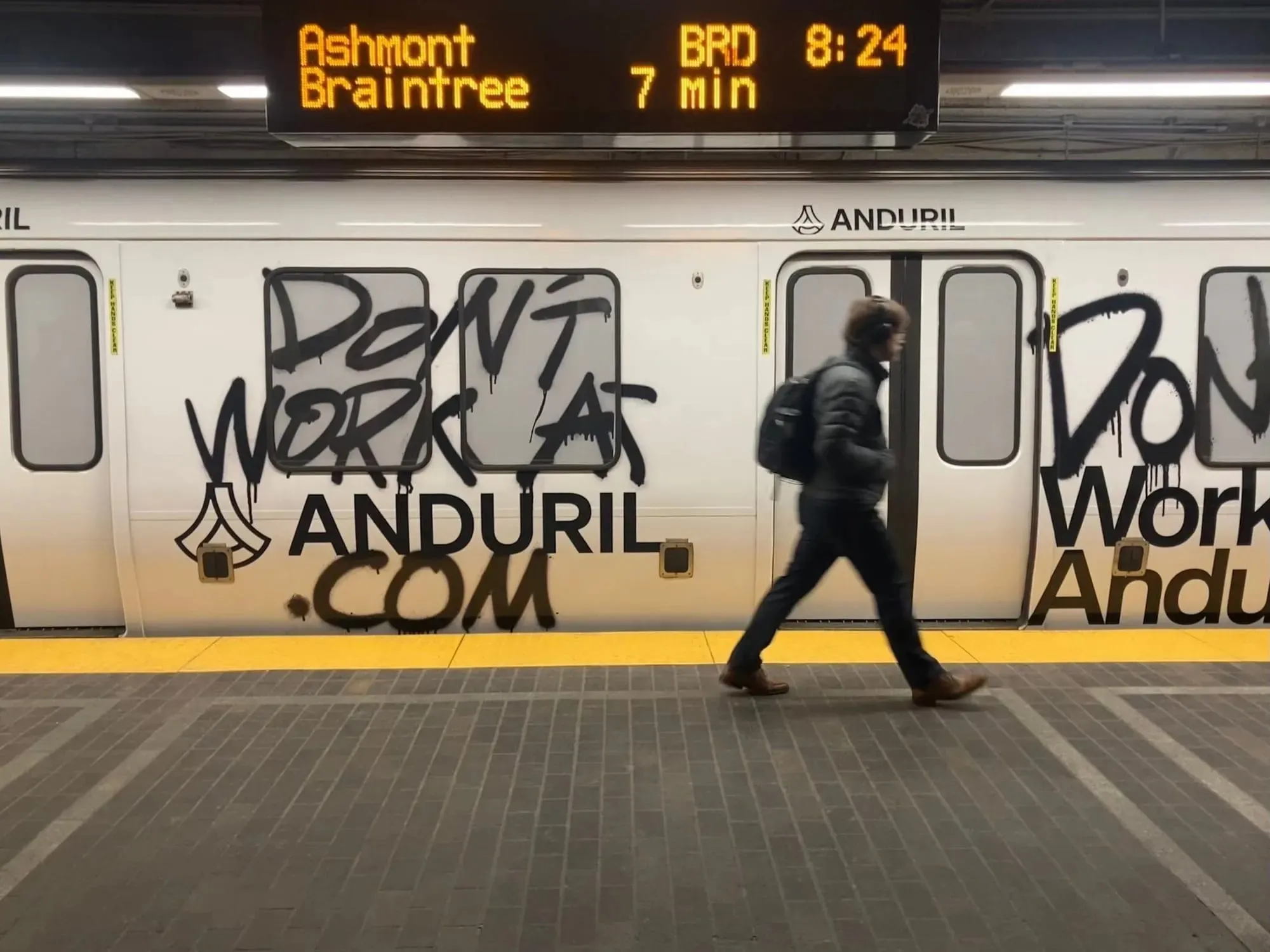
I’m not writing this to recap the campaign. You already know what it is. I’m writing this because I think what’s underneath the campaign is more interesting than the campaign itself — and more relevant to anyone building a company in this space.
dont work at anduril
Anduril Industries on X · Feb 18, 2025
“Don’t Work at Anduril” didn’t come out of nowhere. It’s the visible tip of a narrative strategy that Anduril has been building for seven years, under a very specific set of conditions that most companies don’t share. The campaign reveals something about how narrative actually operates in defense tech — not just how to be clever with an ad, but what it takes to reach a point where this kind of move is even possible.
This isn’t a playbook. Anduril’s situation is unique in ways that matter. But the underlying question the campaign raises — how seriously are you taking your story? — is one worth sitting with.
The Narrative Vacuum
To understand why Anduril would invest this heavily in narrative — and why a recruitment ad would become one of the most talked-about campaigns in the industry — you have to understand the environment they’re operating in. Because when it comes to public storytelling, defense has historically had two modes, and neither one is what Anduril is doing.
The traditional defense primes — Lockheed Martin, Northrop Grumman, Boeing, RTX, General Dynamics — have spent decades operating in near-total narrative obscurity, at least relative to the scale of what they do. Their brands are built for one audience: the Pentagon and Congress. The public-facing presence is corporate, safe, and deliberately forgettable — glossy annual reports, trade show booths, the occasional Super Bowl ad with a soaring eagle. They don’t need consumer brand equity. Their customers are procurement officers, not the general public. And for decades, that worked fine. You don’t need the public to love you when your revenue comes from cost-plus contracts and congressional appropriations.
But that model assumes something important: that no one outside the procurement ecosystem is paying attention, or at least, that their attention doesn’t matter. For the primes, that assumption has mostly held. For the new wave of defense technology companies — the ones recruiting software engineers away from Google, raising venture capital, and building consumer-grade products on Silicon Valley timelines — it doesn’t hold at all. These companies need to hire from a talent pool that has opinions about where they work. They need to raise from investors who care about public perception. And increasingly, they need the public and policymakers to understand why this work matters.
That’s the gap. The primes never needed a public narrative, so they never built one. The new defense tech companies desperately need one, and for a long time, they didn’t have one either — because the dominant public narrative about tech-and-defense was being written by someone else.
The inflection point was Google and Project Maven.
In 2017, Google signed a contract with the Department of Defense to apply AI to drone surveillance footage analysis. It was a relatively modest contract. What happened next was not modest. More than 4,000 Google employees signed a petition demanding the company pull out. Around a dozen resigned. Internal protests erupted. By June 2018, Google canceled the contract and adopted a set of “Ethical AI Principles” that explicitly barred weapons and surveillance applications. They also withdrew from the $10 billion JEDI cloud contract.
For the next several years, Maven became the template: if you work in tech and your company does defense work, you are vulnerable to employee revolt and public shaming. Working on defense in Silicon Valley became, if not career poison, at least something you didn’t lead with at dinner parties.
Here’s the thing about the Maven story that often gets lost in the retelling: Google’s failure wasn’t really a communications failure. It was a strategy failure. Google was a consumer technology company that stumbled into defense work without ever deciding, at a leadership level, whether it wanted to be there. There was no narrative for why Maven mattered because there was no strategic conviction that it did. The vacuum wasn’t created by a bad PR team — it was created by strategic ambiguity. And when you leave ambiguity, other people resolve it for you.
Lt. Gen. Jack Shanahan, who led the Maven project for the DoD, diagnosed it plainly: the decision came from “a lack of transparency, causing the DoD to lose the narrative around its work.” Nobody at Google stood up and said: this matters, here’s why, and we’re proud of it.
The irony, of course, is that by February 2025, Google had quietly erased those AI weapons and surveillance commitments from its principles altogether. The narrative surrender was temporary. But it cost Google years of defense credibility and untold billions in contracts.
So that’s the landscape: primes that never needed a public story and never built one, a cautionary tale from the biggest tech company in the world about what happens when you don’t have one, and a growing cohort of new defense companies that need the public on their side but have no model for how to get there.
David Ulevitch, who leads a16z’s American Dynamism fund, put it well on a recent episode of the Sourcery podcast: “If you want people to believe in transforming the way defense production works in this country, you need the public to come along with you. You need the policy makers to come along with you. And that requires a full-fledged marketing effort.”
Anduril took that lesson — and built an entire company around it.
The Conditions Behind the Confidence
It would be easy to look at “Don’t Work at Anduril” and conclude that the lesson is simple: be bold. Run the provocative campaign. Take the dare. Turn your critics’ language against them.
That would be the wrong takeaway. This campaign works because of a very specific set of conditions that Anduril has spent seven years building — and some that it inherited. Understanding those conditions honestly matters more than admiring the creative.
A founder with nothing left to lose.
Palmer Luckey founded Oculus, sold it to Facebook for $2.3 billion, was ousted after a political controversy, and was physically assaulted at a tech conference for his political views. By the time he started Anduril, his reputation in mainstream Silicon Valley was already in ashes.
As he put it in a Tablet Magazine profile: “I’m the guy who’s already been lit on fire, right? I’ve already been burned. My reputation was so bad that I could do literally anything and it couldn’t get worse.”
That’s not a transferable asset. Most founders don’t have the freedom to be provocative because they haven’t already absorbed the reputational cost. Luckey’s willingness to troll — measuring a model of China’s J-35 fighter with a tape measure at the Singapore Airshow, getting personally sanctioned by China for Taiwan arms sales and wearing it like a badge — isn’t personality. It’s strategy. But it’s strategy that only works because of a very specific personal history.
A narrative strategy from day one.
This is the part that is instructive. Anduril didn’t bolt on a narrative after they had a product. They built narrative alongside the product, from founding.
Lulu Cheng Meservey, co-founder of TrailRunner International, published Anduril’s early comms strategy on Pirate Wires, with a companion podcast featuring co-founder Trae Stephens. The environment they were building in was genuinely hostile: an early investor received angry texts calling his check a “fascist investment.” Cornell University required armed police escorts for an Anduril recruiting session due to violent threats from students. Google canceled Anduril’s business accounts — analytics, YouTube, business tools — for “promoting harm.”
Their response wasn’t to hide. It was to build a comms framework as deliberately as they built their technology stack. The principles from that early strategy read like a founder’s guide to narrative architecture: start with business goals (recruiting and contracts — all comms serve those two objectives), tailor perception to each audience, craft your own narrative in your own voice, propagate inside-out from founders to employees to investors to the public, and embrace the insurgent mindset — turn perceived weaknesses into strengths.
One principle stands out: make attacks costly. The idea being that every time someone attacks you publicly, it should be unpleasant enough for them that the next person thinks twice. That’s not a defensive posture. That’s narrative deterrence.
Consumer-grade creative talent.
Jeff Miller came from Snap. That matters more than it might seem. The “Don’t Work at Anduril” campaign — the graffiti aesthetic, the short film, the LinkedIn profile takeover — isn’t something a traditional defense marketing team would conceive of, let alone execute. Miller brought a consumer creative sensibility to an industry that typically communicates through white papers and trade show booths.
As Miller told Entrepreneur: “Our ‘Don’t Work’ campaign brings to life one of the core differentiators of Anduril’s culture: the collective buy-in to hard, mission-driven work. Anduril is not for everybody, that’s the point.”
A $30 billion valuation and cultural tailwinds.
This campaign lands differently at a $30.5 billion valuation than it would have at $300 million. At scale, the confidence reads as earned. At an early stage, this same energy might read as reckless or try-hard.
And the timing matters. This isn’t 2018. The broader cultural landscape has shifted dramatically: venture capital poured $28 billion into defense tech in the first half of 2025 alone — compared to $18 billion for all of 2019. OpenAI dropped its military restrictions and secured a $200 million DOD contract. The Army launched Detachment 201, fast-tracking tech executives from Meta, OpenAI, and Palantir into Reserve lieutenant colonel roles. Anduril topped the 2025 CNBC Disruptor 50 list — the first time a defense tech company has ever held the #1 spot.
Patriotism in tech is ascendant. Building for national security is no longer something you whisper about — it’s something you put on a billboard. The “Don’t Work at Anduril” campaign is riding a wave, not creating one. But Anduril helped build that wave over seven years of deliberate narrative work, and now they’re surfing it better than anyone.
The “no renders” credibility bank.
One detail from the Sourcery podcast discussion of the campaign is worth highlighting: Anduril operates on a “no renders” rule. Palmer Luckey insists that all marketing materials show real hardware in real tests — not the CGI mockups and conceptual animations that legacy defense contractors typically use to sell programs.
This matters because boldness without credibility is just noise. The “Don’t Work” campaign can afford to be provocative because everything else Anduril puts out — every product demo, every test video, every public appearance — has an authenticity to it that the audience can feel. The campaign is the tip of a very deep iceberg. Without the iceberg, it’s just a stunt.
Introducing Roadrunner and Roadrunner-M — a radical new class of recoverable autonomous air vehicles that are built to address today's threats and ready for the threats of tomorrow.
Anduril Industries on X · Nov 30, 2023
What They Actually Did
The campaign mechanics are worth examining closely, because they reveal how much thought went into what might look, at first glance, like a simple provocation.
The OOH placements were surgical. Boston (Harvard, MIT, Red Line subway stations), Atlanta (Georgia Tech), Seattle (near Amazon HQ and Pike Place). These aren’t random metros — they’re the densest concentrations of the exact engineering talent Anduril needs to hire. Every billboard is a recruiting billboard, placed where elite technical talent commutes.
The creative layering was deliberate. The graffiti-style “Don’t” spray-painted over a clean corporate ad. Other versions feature text blocked out with red, white, and blue spray paint. The whole thing is designed to look vandalized — to evoke the aesthetic of protest without actually being protest. It’s a company dressing in its critics’ clothing.
The multi-channel execution amplified reach. The short film. The LinkedIn profile pictures. The landing page. Each element gave the campaign a different surface area for sharing and conversation. The LinkedIn execution was particularly smart — employees changing their profile pictures to mimic hiring banners, but reading “Don’t Work At Anduril” — turned Anduril’s own workforce into a distributed marketing channel.
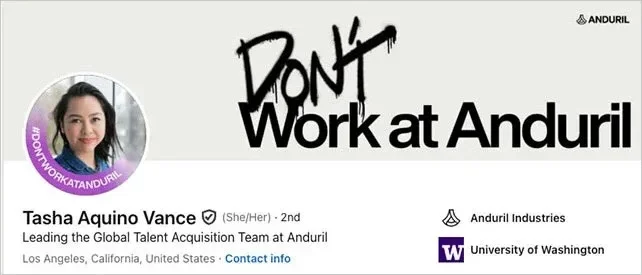
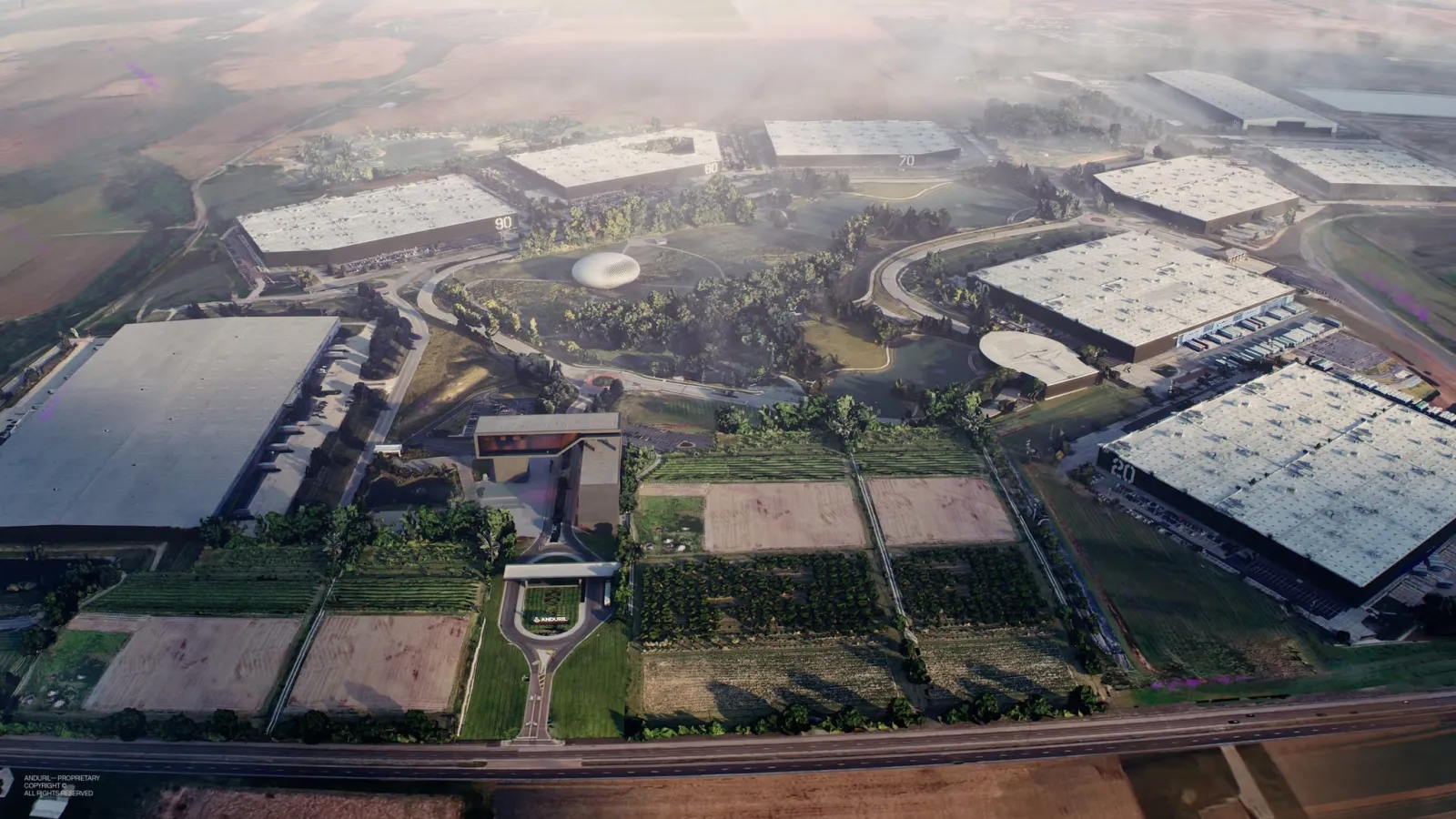
The timing was strategic, not accidental. The campaign launched alongside Anduril’s takeover of Microsoft’s $22 billion Army goggles contract and more than $200 million in additional defense contracts. Arsenal-1, Anduril’s massive new manufacturing facility in Columbus, Ohio — 5 million square feet, $900 million investment, 4,000+ new workers — was ramping up. They need to hire thousands of people. This isn’t brand awareness for brand awareness’s sake. It’s an employer brand campaign with a very specific talent pipeline purpose.
If you’ve watched Netflix’s marketing operation, the DNA is familiar. In 2017, Netflix placed stark black-and-white billboards across New York and LA that read simply: “NETFLIX IS A JOKE.” No context, no logo treatment, no explanation. Speculation erupted — was it a competitor’s attack? A disgruntled employee? The reveal, timed to the Emmys, reframed it as a promotional campaign for their comedy lineup. It generated millions in earned media.
The shared playbook: take what your critics might say about you, say it first, say it louder, and say it with better production value. Turn the insult into the brand.
The difference is stakes. Netflix was selling comedy subscriptions. Anduril is recruiting engineers to build autonomous weapons systems for the U.S. military. The “Don’t Work at Anduril” campaign operates in a space where real people really do protest the company — making the co-optation more daring, and the creative decision more revealing.
new official onboarding video plz dont tell hr
Anduril Industries on X · Feb 19, 2025
What This Tells Us About the Industry
There is real, organized opposition to Anduril and to the broader defense tech industry. In Columbus, community groups including Veterans for Peace and the No Anduril Plant coalition have organized against Arsenal-1. Nationally, Engineers Against Apartheid protested Palmer Luckey’s appearance at the Reindustrialize Summit in Detroit. No Tech for Apartheid, which started with Google and Amazon’s Project Nimbus contract, has expanded its scope to the broader defense tech ecosystem.
These groups are organized and coordinated. They’re also, at this point, swimming against a very strong current. A $28 billion investment wave. Bipartisan support for defense modernization. A cultural moment in which building for America’s defense is not just tolerated in tech circles but increasingly celebrated. The opposition is real, but it represents a shrinking cultural position, not a growing one.
The more interesting reference point is Palantir.
Palantir isn’t failing. Not remotely. The company was the second-best performing stock in the S&P 500 in 2025. Revenue is soaring from government contracts. They’ve moved their headquarters from Palo Alto to Denver to Miami. They’re deeply embedded in DOD and intelligence community work.
And yet — coordinated “Purge Palantir” protests across five or more U.S. cities. Former employees publishing open letters condemning the company. Twenty years of contested public perception that never fully resolves.
That’s not a cautionary tale about failure. It’s evidence that narrative is a permanent front — not a battle you win once. Even with a market cap exceeding $100 billion, the story is still contested. That has real costs: in recruiting, in employee morale, in the kind of talent that self-selects in or out, in the energy leadership has to spend managing perception instead of building product.
Anduril appears to be trying to get ahead of that same cycle — claiming the narrative territory so aggressively, so early, that the cultural ground is already occupied by the time the opposition arrives in force. Whether that works over a twenty-year horizon is an open question. But the “Don’t Work at Anduril” campaign is evidence of how seriously they’re taking the attempt.
The Questions This Raises
I run a brand and marketing practice for hard tech called Relay. So I spend a lot of time thinking about how companies in these sectors build, defend, and evolve their public stories. The temptation with a case study like this is to extract a set of lessons and hand them out as a framework. Do it like Anduril. Be bold. Lead with the founder. Co-opt your critics.
I’m not going to do that. Because the honest truth is that most of what makes this campaign work is specific to Anduril — specific to Luckey’s backstory, to seven years of deliberate narrative infrastructure, to a $30 billion valuation that makes boldness feel earned, to a VP of Marketing with a consumer creative pedigree that most defense companies wouldn’t think to hire for, and to a cultural moment that happens to be moving in exactly their direction.
Copying the aesthetic without the foundation would fall flat. Or worse — it would come across as try-hard, which in this industry is worse than saying nothing at all.
What is transferable are the questions the campaign surfaces. And I think these are worth sitting with if you’re building in this space:
When does narrative become a strategic priority?
Anduril started at founding. Most companies don’t. Is there a point in a company’s lifecycle where it becomes urgent? Is it when you start hiring at scale? When you face your first public controversy? When you take government money? When you break ground on a factory? The answer is probably “earlier than you think” — but the specifics depend entirely on your company, your market, and your threat landscape.
What does founder-led narrative look like when the founder isn’t Palmer Luckey?
Luckey is an outlier — someone whose personal history and temperament make him a natural provocateur. What does authentic, founder-led narrative look like for a technical CEO who’s more comfortable in a lab than on a podcast? The principle — that only the founder can be the chief evangelist for a mission-driven company — is sound. But the execution can’t be imported. A quiet, technically brilliant founder trying to do a Palmer Luckey impression would be painful to watch. Your version of founder-led narrative has to come from who you actually are.
What’s your version of “no renders”?
Anduril’s authenticity comes from showing real hardware in real tests. If your product is software, or classified, or still in development — what does authenticity-first marketing look like for you? The principle — earn credibility before you spend it — transfers. The tactic doesn’t. But every company has something that’s real, that’s demonstrable, that audiences can feel isn’t fabricated. Finding that thing and leading with it might be the most important marketing decision you make.
Can you build a public constituency before you need one?
Ulevitch’s insight — that you need the public and policymakers to come with you — is easy to agree with in the abstract. In practice, it means spending real money on marketing and narrative at a stage when most defense companies see it as a luxury, or worse, as frivolous. When does that investment make sense? And when is it premature? There’s no universal answer. But the Google counter-example is instructive: the cost of not having a public constituency when you need one can be measured in billions of dollars of lost contracts.
Does your national narrative work locally?
“Defending America” resonates broadly. It doesn’t automatically translate when you’re building a factory in someone’s backyard, or recruiting at a university with an active anti-war movement, or seeking zoning approval from a township board. Columbus, where Anduril is building Arsenal-1, is the emerging test case. The community opposition there isn’t about geopolitics — it’s about noise, traffic, environmental impact, public subsidies, and who gets to decide what comes to the neighborhood. If you’re expanding into manufacturing, community economic development, or any kind of physical footprint, you need a local story that stands on its own. The national brand can’t do that work for you.
The Story Underneath the Story
Come back to that subway ad in Boston. The spray-painted “Don’t” over “Work at Anduril.com.”
What looks like a single provocative creative decision is actually the visible tip of seven years of narrative infrastructure: a comms strategy built at founding, a founder whose personal brand is inseparable from the company’s identity, consumer-grade creative talent applied to an industry that usually communicates in white papers, a rule about never showing anything that isn’t real, and a cultural moment that happened to arrive right on time.
The campaign itself isn’t replicable. The conditions are too specific, the ingredients too particular to Anduril’s history and position.
But the underlying conviction — that narrative deserves the same strategic seriousness as product development, engineering, and sales — is universal. And it’s the one thing that the Google comparison, the Palantir reference, and Anduril’s own trajectory all point to: the companies that treat their story as infrastructure tend to control it. The companies that treat it as an afterthought tend to lose it.
How each company acts on that conviction will look completely different. It should.
Originally published on X. Follow Robert Johns.